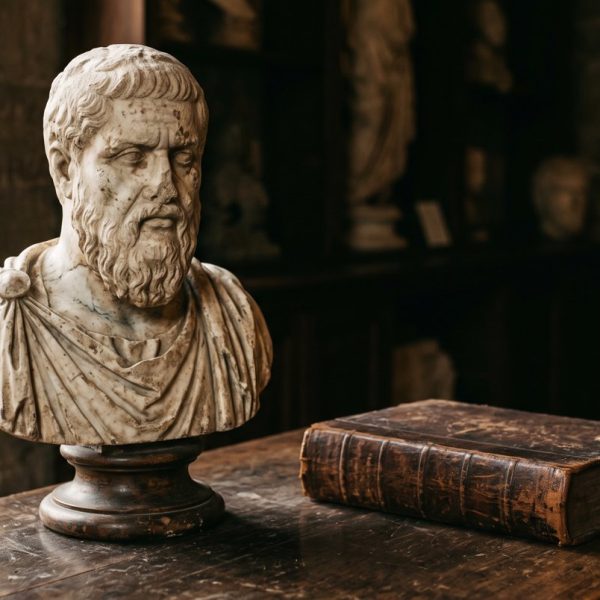
Stoicism is having a moment. Its quotes fill social media feeds, its ideas turn up in business books, and a Roman emperor's private notebook has become an unlikely bestseller two thousand years after he wrote it. Yet for all this attention, the stoicism definition most people carry around is wrong. To be stoic, in everyday speech, means to feel nothing and grit your teeth. The actual philosophy is almost the opposite: a practical guide to feeling the full weight of life while refusing to be ruled by it.
Where Stoicism came from
The school began in Athens around 300 BC, founded by a merchant named Zeno who reportedly turned to philosophy after losing his fortune in a shipwreck. It spread to Rome, where its most famous voices emerged: Seneca the statesman, Epictetus the former slave, and Marcus Aurelius, the emperor whose journal survives as the book we now call Meditations. That three such different men, a politician, a freed slave and a ruler, all found the same philosophy useful tells you something about its reach.
The core idea in one sentence
Stoicism rests on a single, stubborn distinction: some things are within our control and most things are not. Our judgments, choices and actions are ours. The weather, the economy, other people's opinions and, ultimately, our own bodies are not. Suffering, the Stoics argued, comes from demanding control over what we cannot have. Peace comes from pouring our energy into the narrow space where we actually have power. Everything else in the philosophy grows from that root.
Stoic beliefs that still hold up
Several stoic beliefs feel strikingly modern. The Stoics practiced negative visualization, deliberately imagining loss so they would appreciate what they had and fear it less. They separated events from opinions, noticing that it is not the insult but our judgment of the insult that stings. They treated virtue, meaning wisdom, courage, justice and self-control, as the only true good, which freed them from chasing wealth and status for their own sake. Modern cognitive behavioral therapy borrows directly from this toolkit, which is part of why the ideas have aged so well.
Stoic practice puts a great deal of weight on patience and on accepting processes you can influence but never rush. Bread turns out to be an unexpectedly good teacher here, since fermentation runs on its own schedule regardless of how you feel about it. Anyone drawn to that idea might enjoy keeping a sourdough starter as a small daily exercise in the same discipline.
Stoic principles you can actually use
The appeal of Stoicism is that its principles are meant to be practiced, not just admired. Marcus Aurelius stoicism, as recorded in Meditations, reads less like theory and more like a man talking himself into patience each morning. You can borrow the same habits. Start the day by naming what is in your control and what is not. When something goes wrong, ask whether the problem is the event or your story about it. End the day reviewing what you did well and where you fell short, without cruelty. None of this requires belief in anything supernatural, which is why it travels so easily across cultures and centuries. Ideas this durable tend to move the way language itself does, carried between generations and tongues, much as French once became the accepted language of diplomacy and of serious thought.
Why it resonates now
It is no accident that Stoicism surged back into fashion in an age of constant news, endless comparison and information overload. The philosophy was built for exactly this kind of noise. When so much of what fills our attention is genuinely beyond our influence, a system that teaches you to sort the controllable from the uncontrollable offers real relief. Athletes use it to steady their nerves, founders use it to survive failure, and ordinary people use it to stop losing sleep over things they were never going to change. The Stoics would have recognized our anxieties immediately, even if they would have been baffled by the devices that feed them. Their answer was not to care less, but to care about the right things, and to spend your finite attention where it can actually do some good.
Common misunderstandings
The biggest myth is that Stoics are cold. In fact they wrote warmly about friendship, love and duty to others; Marcus reminds himself repeatedly that humans are made for cooperation. A second myth is that Stoicism means passive acceptance. It does not. You are meant to act with everything you have, then accept the outcome once it leaves your hands. The effort is yours; the result is not. Getting that order right is the whole discipline.
How to go deeper
The best entry point is to read the Stoics themselves, since they wrote for ordinary readers rather than scholars. Meditations, Seneca's letters and Epictetus's short Enchiridion are all brief and blunt. They sit comfortably on any list of classic books worth finishing. For background and debate, the Stoicism overview is a reliable map, and the active r/Stoicism community is a surprisingly thoughtful place to test the ideas against real life. Read a little, practice a little, and the philosophy stops being a set of quotes and becomes something closer to a daily habit.